

Military Sexual Trauma: Why Accountability Is the Proven Solution
Military Sexual Trauma prevention requires accountability, not just awareness. Learn why consequences stop sexual assault and what 40 years of research proves works.

Military Sexual Trauma won't stop with awareness campaigns alone. In this episode of The Silenced Voices of MST, expert Chuck Derry, founder of The Gender Violence Institute, shares 40 years of research proving accountability is the only solution that works.
Chuck Derry, founder of The Gender Violence Institute, shares his extensive experience in addressing gender violence, offering insights into its cultural roots, the importance of accountability, and the personal reflections necessary for achieving true equality. This episode describes Derry's work and perspectives, providing a comprehensive overview of his approach to combating abuse and enacting cultural change.
Content Warning: This episode and article discuss gender violence, domestic violence, sexual assault, Military Sexual Trauma, abuse dynamics, and systemic failures in addressing violence. Please engage with this content when you feel safe and supported.
In episode 43 of The Silenced Voices of MST, Chuck Derry, founder of The Gender Violence Institute, shares his extensive experience in addressing gender violence, offering insights into its cultural roots, the importance of accountability, and the personal reflections necessary for fostering equality. He has worked to end men's violence against women since 1983 which resulted in co-founded the Gender Violence Institute in 1994. His decades of experience offer critical insights for those working to address Military Sexual Trauma, as the dynamics he documented in civilian domestic violence cases mirror what happens in military systems where sexual assault thrives.
Chuck Derry: 40 Years of Proven Gender Violence Prevention Research
Chuck Derry, with over 40 years of experience since 1983, discusses his transformative journey in gender violence intervention. Initially, he worked with feminist women to combat men's violence against women, an experience that profoundly shaped his understanding. Derry emphasizes that 95% of his knowledge comes from learning from women, while the remaining 5% is based on his experiences as a white male growing up in Minnesota, navigating sexist and racist societal norms. His approach centers on accountability, cultural change, and the willingness of individuals to examine their own complicity in systems that perpetuate violence.
How Gender Violence Begins: Cultural Roots of Violence Against Women
Initially, Derry reflects on his early experiences and realizations about gender dynamics. He recalls understanding at a young age that being a girl was considered the worst thing, influencing his behavior to align with perceived masculine ideals. He shares an anecdote from Catholic school where boys would expose girls' underwear. Adults saw it happen and did nothing. The message was clear that boys were more important than girls.
Derry points out that statistics show girls in the U.S. face a one in three chance of being beaten by a partner and a one in two chance of being sexually assaulted. These statistics are an unsettling reminder of the pervasive cultural issues that begin in childhood and continue throughout life. The normalization of disrespect and violence toward girls creates a foundation for the gender violence that persists in adulthood and globally across institutions, including the military.
Military Sexual Assault: How Military Culture Protects Perpetrators
The conversation shifts to the military, where values of honor and integrity coexist with significant problems of sexual assault. Rachelle shares a personal experience of sexual assault at a VFW, remembering how deeply ingrained cultural norms can override stated values. She notes that even when incidents are reported, varying definitions of consent among jurors in military courts can alter outcomes. Accountability must be consistently adhered to, rather than relying on subjective interpretations that often favor perpetrators.
The contradiction between military values and the reality of sexual assault rates is evidence of a structural problem. Systems that center male power often protect male violence. The burden falls on survivors to prove what happened, while perpetrators benefit from doubt, confusion, and institutional protection.
Proven Accountability Program: How the Duluth Model Changes Abusive Behavior
The 24-week program Chuck led was designed to address abusive behavior. Men ordered to participate must acknowledge their violence and understand the power and control dynamics involved. The program uses the Duluth Power and Control Wheel, requiring men to log instances of physical and emotional abuse, intimidation, and other controlling behaviors.
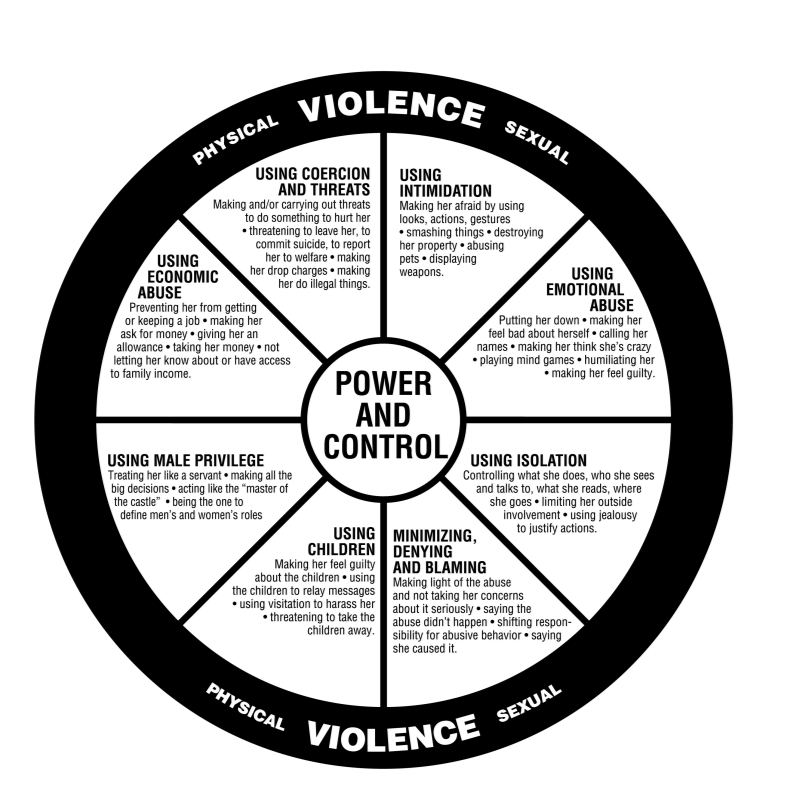
Battering is one form of domestic or intimate partner violence. It is characterized by the pattern of actions that an individual uses to intentionally control or dominate his intimate partner. That is why the words “power and control” are in the center of the wheel. A batterer systematically uses threats, intimidation, and coercion to instill fear in his partner. These behaviors are the spokes of the wheel. Physical and sexual violence holds it all together—this violence is the rim of the wheel. (Duluth Model)
The Duluth Model's Power and Control Wheel is a tool developed in the 1980s through focus groups with female survivors. Women compiled lists of the types of abuse most commonly used against them. The wheel helps survivors step back and see the full scope of violence they have experienced. It gives them language to name what happened. For many survivors, that validation changes everything.
Derry is careful to note that participants were initially resistant, often minimizing, denying, and blaming. However, the structured accountability led to significant changes. The consequences, enforced by the criminal justice system, probation officers, and community support, were essential to deterring abusive behavior.
Why Perpetrators Continue Violence: Understanding the Benefits of Abuse
One experience in particular stood out most in this program. Chuck Derry spent years sitting across from men who had been court-ordered into his program after harming their partners. He asked them to do something most had never done: list the benefits they got from their violence.
At first, they resisted. Then they filled a four-by-eight-foot blackboard.
The list included advantages such as maintaining control, gaining money, avoiding change, dictating reality, determining what values their kids would have, controlling where their partner went and who they talked to, and deciding when and how sex happened. The list went on for hours. This exercise, conducted in the 1980s and 90s as part of a structured accountability program in Minnesota, revealed something that survivors already knew but systems refused to acknowledge. Violence works for perpetrators until someone makes it stop.
These deep-seated reasons why men perpetuate abusive behavior, even if they themselves are not abusive. The difficulties in relinquishing these perceived benefits is what perpetuates “looking the other way” or not speaking up against it. Understanding these benefits is crucial for developing effective intervention strategies.
Military Sexual Trauma Prevention: Why Accountability Is the Missing Piece
Accountability is crucial in preventing MST. Consequences, enforced by the criminal justice system, probation officers, and community support, were essential to deterring abusive behavior in his program. He shares that men who were kicked out of the program for not taking responsibility often returned, admitting they could no longer get away with it.
The Pentagon nearly doubled its sexual assault prevention budget to more than $1 billion in 2023 and 2024. They established new offices to prosecute cases outside the traditional chain of command. They hired about 1,400 trained prevention specialists to serve at bases around the globe. However, while 8,195 sexual assaults were reported in 2024, independent research estimates the actual number may be 2-4 times higher. Dr. Jennifer Greenburg's research estimated approximately 73,695 cases of sexual assault in the military in 2023, nearly nine times the number of official reports.
The gap between what happens and what gets reported reveals everything about the lack of accountability. Derry's work identified the two factors most strongly associated with men who perpetrate violence: childhood experiences of abuse and witnessing violence, and attitudes related to gender equity. He also identified what keeps violence going: impunity. When perpetrators face no consequences, they have no reason to stop. The benefits outweigh the risks. The behavior continues because it works. Awareness campaigns and training modules alone cannot stop sexual assault. Accountability through consequences and other men speaking up and influencing other men stops it.
Gender Equality: What Men Must Sacrifice to End Violence Against Women
Derry reflects on the personal sacrifices required to achieve true equality. He questions whether men are willing to give up the benefits and privileges they receive in a sexist culture. This includes confronting male bonding over objectification, stopping the use of pornography, listening to women, and relinquishing leadership positions if necessary.
The list includes things men rarely talk about, such as male bonding over objectification, pornography use, dominating conversations, holding leadership positions they are not qualified for simply because they are men, controlling household decisions, and dictating when and how sex happens. The benefits of sexism are real, tangible, and daily.
Giving them up requires more than good intentions. It requires confronting how deeply those benefits are woven into identity, relationships, and career advancement. In military contexts, this means confronting how sexual violence functions as a tool of dominance and control, how it reinforces hierarchies, how it silences dissent, and how it maintains power structures that benefit some service members at the expense of others.
Derry challenges men to consider what kind of human being they want to be and whether they care about the lives of others. The ratio of learning from women versus his own experience matters, because it tells us who holds expertise, whose voices should lead prevention efforts, and why survivor-centered approaches work and top-down institutional responses fail.
How Military Sexual Trauma Survivors Can Demand Accountability
Chuck Derry's decades of work in gender violence intervention offers a clear roadmap for addressing Military Sexual Trauma. Violence works for perpetrators until someone makes it stop. Awareness campaigns, training modules, and billion-dollar budgets cannot replace genuine accountability. Systems must create and enforce real consequences for perpetrators while centering survivor voices and experiences.
For survivors of MST, your story holds expertise that no institutional training can replicate. Your insistence on accountability is not asking too much. You deserve justice, support, and systems that prioritize your safety over institutional reputation. The work of creating change requires all of us to examine our complicity in systems that protect perpetrators and to demand better from our military institutions.
Resources for Veterans Seeking Help
If you are a Military Sexual Trauma survivor, The Silenced Voices of MST offers several free resources and tools to support your journey:
VA Disability Toolkit: A free resource built to help you organize the VA claim process with tips and strategies from those who have successfully navigated the system. Document your trauma, track your claim, and organize every detail for a stronger case.
Contact Your Lawmaker Toolkit: Make your voice heard in Congress. This toolkit allows you to easily and safely contact members of Congress about MST-related legislation, military reform, or your personal experiences with templates and state-specific lookup.
The Advocates of MST Private Facebook Group: Join a safe, private community where survivors can connect, share experiences, and access peer support without fear of retaliation or judgment.
Crisis Support: If you are in crisis, please reach out:
Veterans Crisis Line: Call 988 and press 1, or text 838255
National Sexual Assault Hotline: 1-800-656-4673 (RAINN)
DoD Safe Helpline for Military Sexual Assault: 1-877-995-5247
Episode Chapters and Timestamps
00:00 Meet Chuck Derry, Founder of The Gender Violence Institute
03:48 Childhood Memories of Cultural Behavior Towards Girls and Women
05:49 Military Culture and Rachelle's SA at the VFW
10:15 The 24-Week Program That Successfully Changed Behavior
12:07 The Benefits of Abusive Behavior
16:01 The Missing Piece in Prevention of MST
17:54 Chuck's Reflections on Life if Equality Actually Happened
Frequently Asked Questions
-
The Duluth Model Power and Control Wheel is a tool developed in the 1980s through focus groups with female survivors of domestic violence. Women compiled lists of the types of abuse most commonly used against them. The wheel helps survivors understand the full scope of violence they have experienced by identifying patterns of physical violence, emotional abuse, intimidation, isolation, economic abuse, and other controlling behaviors. It gives survivors language to name what happened to them.
-
Perpetrators continue abusive behavior because it provides tangible benefits and they face no consequences. The benefits include maintaining control over others, gaining financial advantages, avoiding personal change, dictating reality in relationships, determining family values, controlling where partners go and who they talk to, and deciding when and how sex happens. When there is no accountability, the benefits outweigh any risks, so the behavior continues.
-
Cultural factors that contribute to gender violence include societal norms that devalue girls and women from childhood. Boys learn early that being a girl is considered inferior, which shapes attitudes and behaviors. Adult inaction when boys mistreat girls reinforces the message that boys matter more than girls. Statistics show that girls in the U.S. face a one in three chance of being beaten by a partner and a one in two chance of being sexually assaulted. These cultural patterns begin in childhood and persist throughout life.
-
Achieving gender equality would require men to give up significant benefits and privileges. This includes male bonding over objectification of women, pornography use, dominating conversations, holding leadership positions they are not qualified for simply because they are men, controlling household decisions, and dictating when and how sex happens. These benefits are woven into male identity, relationships, and career advancement. Giving them up requires more than good intentions. It requires confronting complicity in systems that perpetuate inequality.
-
Accountability is the crucial missing piece in preventing Military Sexual Trauma. Without real consequences for perpetrators, sexual assault continues because it serves the perpetrator's interests. Awareness campaigns and training programs alone cannot stop sexual assault. Systems must create meaningful consequences that are consistently enforced through the criminal justice system, command structures, and community support. When perpetrators face genuine accountability, they can no longer get away with their actions.
-
The gap between actual sexual assaults and reported cases in the military is significant. While 8,195 sexual assaults were reported in 2024, independent research estimates the actual number may be 2-4 times higher. Dr. Jennifer Greenburg's research estimated approximately 73,695 cases of sexual assault in the military in 2023, which is nearly nine times the number of official reports. This gap reveals the lack of accountability and trust in military reporting systems.
-
Survivors do not report for several reasons. Many want to forget about the assault and move on. They do not want more people to know what happened. They feel ashamed or embarrassed. Among servicewomen who did report, 38 percent experienced professional reprisal, 51 percent experienced ostracism, and 34 percent experienced maltreatment. The consequences of reporting fall on survivors rather than perpetrators, which discourages reporting.
-
Accountability programs can be effective when they require participants to acknowledge their violence, understand power and control dynamics, and face consistent consequences. The 24-week program that Chuck Derry helped develop required men to log instances of abuse and understand the Duluth Model. Initially, participants minimized, denied, and blamed. However, structured accountability enforced by the criminal justice system, probation officers, and community support led to significant behavioral changes. Men who were removed from the program for not taking responsibility often returned later, admitting they could no longer get away with their behavior.
-
The Gender Violence Institute was co-founded by Chuck Derry in 1994. The organization works to end gender violence through an approach that recognizes the connections between violence, power, and privilege. The Institute engages in community organizing, policy development, education, and training. Their work emphasizes that individual behavior change alone cannot end sexual assault. Systems and cultures must change, and consequences for perpetrators must be real and consistent.
-
Military culture contributes to sexual assault when stated values of honor and integrity coexist with systems that protect perpetrators. Deeply ingrained cultural norms can override stated values. Varying definitions of consent among jurors in military courts can alter outcomes. Systems that center male power often protect male violence. Sexual violence functions as a tool of dominance and control, reinforces hierarchies, silences dissent, and maintains power structures that benefit some service members at the expense of others.
About the Guest
Chuck Derry is the founder of The Gender Violence Institute. Since 1983, he has worked to end men's violence against women through accountability programs, community organizing, policy development, and education. His approach centers on understanding the cultural roots of gender violence and creating systems that hold perpetrators accountable while supporting survivors.
Help Support our Mission
This work saves lives. Every story shared, resource created, survivor connected to help. The Silenced Voices of MST exists because too many survivors have been silenced for too long. This work is necessary, but it cannot continue as a one person sacrifice. I am asking for your support to help transition this platform into a sustainable resource. If this mission matters to you, please consider making a donation or sharing this campaign with your network. Every episode produced, every toolkit distributed, every survivor story amplified requires resources. Production costs, hosting fees, website maintenance, and platform development all depend on the generosity of people who believe survivors deserve better.
Your donation directly funds:
Administrative Support: $12,000 to hire a part-time assistant. This is the only way to shift the twenty-person workload off of one individual and ensure the show’s longevity.
Operational Recovery: $8,500 to address the debt incurred by the show's operations since 2023. This is essential to stop the cycle of negative balances and financial instability from paying for the show with VA disability
Production & Security: $4,500 to cover the upcoming year of hosting, extra security features for guest safety, and necessary software subscriptions.
Thank you for standing with survivors.
About the Host
Rachelle Smith is an Air Force veteran, MST survivor, and the founder of The Silenced Voices of MST, an advocacy platform focused on Military Sexual Trauma. With a background in Communications and a distinguished career as a US Air Force Public Affairs Officer, Rachelle is committed to amplifying the voices of survivors and demanding accountability from institutions that have failed them.
After years of struggling in silence, Rachelle created The Silenced Voices of MST to help this long-ignored community document their truth, speak out, and fight for future service members. The platform offers the VA Disability Toolkit, the Contact Your Lawmaker Toolkit, guided trauma recovery journals, and leads The Advocates of MST, a private Facebook support group.
Through her podcast, Rachelle provides a safe space for MST survivors to share their stories, access resources, and find community. Her work centers on visibility, support, and accountability for Military Sexual Trauma survivors worldwide.
Connect with Rachelle: silencedvoicesmst.com | Email: info@silencedvoicesmst.com
-
Chuck Derry (00:00)
we first started working with batterers in 80s, we thought, oh, these guys just didn't have the life skills they need to address their emotions, or they lost control, And then we find out they'd use those life skills as a more sophisticated way to
And that's when we realized this is very conscious behavior. They know exactly what they're doing.
Chuck Derry with the Gender Violence Institute in Clearwater, Minnesota. I've been doing this work since 1983, 41 years. I was 27 when I started. And it was amazing. It transformed my I started working with feminist women to end men's violence against women and just blew me away.
And 95 % of what I share, I learn from women. as a guy, I'm always expected to be the % of what I share with you, learned from women. And the other 5 % is what I'll share about just being a white boy in Minnesota growing up and US and the sexist, racist stuff that.
was embedded into my bones.
Rachelle Smith (01:11)
Yeah, and unfortunately that's just a part of American culture and we got a long way to go in changing all of that. what were the things that came to pass in your life that led to starting this institute?
Chuck Derry (01:23)
Well, in my early 20s, I was doing roofing and carpentry. And my wife at the time got a job in St. Cloud at the women's shelter, battered women's shelter. And I knew carpentry wasn't quite what I wanted to do with my life. So I kind of put it up to the universe for what could happen next and show me a path and
we moved st cloud and a friend of some friends of mine started the St. Cloud Intervention Project which is based off intervention project and it was really getting criminal justice system to do something about men abusing women and part of that was guys would be arrested they have jail time over the head and then they have come twenty four week accountability groups and they were looking for somebody to facilitate these accountability groups
So I went in there and here's how high the bar was. This is 83. The guy before me, asked him, so what do you think about sexism? He said, sex, I like sex. Sex is good. So I knew what sexism was. That's how I got hired. Because I knew it's, that's how high the bar was. Because in the US, we're just starting to work with men who batter. and I thought, this would be interesting, but it totally transformed my
Rachelle Smith (02:22)
boy.
Chuck Derry (02:35)
started working in this feminist women's organization, I thought I was a pretty nice guy. didn't think I was very racist and stuff. And then I found out my big toe was sexist. It wasn't just this little attitude, it was bone deep. And so it's very amazing how much it challenged me about my male privilege. And then also challenged me about, I care about women's lives? What kind of human being do I wanna be? And then also working within the system, the male system.
To get them to actually arrest men who are beating and raping their wives and children. Because that wasn't happening. every lie I was told about girls and women, they're stupid, they're emotional, they're weak, was all revealed to me. doing this work. And it's just been amazing. I've worked with amazing women. And I've been a very, very lucky, man.
Rachelle Smith (03:19)
just, I can't imagine how sobering that must've been there's this entire, web or blanket or whatever you want to call it. That's thrown over men's eyes. to where they can't really see us as people, unfortunately.
Chuck Derry (03:37)
a, yeah, that's why it transformed my life. I was so lucky to be with women who would debate me.
about sexism, they'd argue with me, they'd even be willing to get angry with me rather than just blow me off.
I was just really lucky.
there's all kinds of stories I can tell about, okay, how this impacted how I with friends and towards girls and
what I grew up with.
Worst thing I'd be in first grade, was six years old. I realized I was going to a little Catholic school and then.
I realized the worst thing I could be is a girl.
throw a ball-like girl or a run-like Anything like a girl. That's how I knew I was the right kind of boy. I looked around my world in 60s. The men were in charge everywhere. so I'm six years old. Didn't take a rocket scientist to figure out if the worst thing I'd be as a girl, then boys are better than girls. ⁓ duh. And then how do we change our behavior with the girls when we thought we were better? And I'll give you one example. In second grade, I was in Catholic school.
and we had to wear uniforms. So the girls had to wear dresses down to their ankles and we had to wear ties. At recess, we'd run after the girls and we'd grab their dresses and we'd say, Tuesday, dress up day. And we'd throw their dresses up in the air so we could see their underwear. They had polka dots on their underwear or butterflies. Oh, we'd be rolling around on the ground laughing and they'd be going, get out of here, leave me alone. Which was part of the fun. the girls all started coming to school with culottes. What we called culottes in those days, they were shorts.
to school wearing shorts underneath their dresses because of what the boys are doing. And there were adults in that playground who had to have seen this and did nothing. As they just went, will be boys, boys are enjoying themselves, okay, they're more important than the girls, apparently. So, I mean,
The cultural stuff the stats I've seen is if you're born a girl child in US, you have a one in three chance of being beaten by the man you're in relationship with, the Center for Disease Control came out with a research last year that said if you're born a girl child in the United States, you have a one in two chance of being sexually assaulted.
the women we know, one of women in our family, one of women we work with. and it's men who are beating and raping these women. And that many men could not be beating and raping this many women without widespread cultural support.
How do we change these cultural norms to stop it before it starts?
Rachelle Smith (05:49)
it's just this reality that we have to face that is baked into our culture, like you said, and our military service, it's like 1 % of Americans serve. we're in this.
much smaller environment where these behaviors become readily apparent. But when you're in basic training and they're putting all the military values in you it's honor, it's integrity, it's look out for the person on your left and right, it's, protecting people. it just somehow does not translate once you
get to tech school or your duty station and some people they don't even get to the part where they get the values and basic like they're just trying to take their ASVAB and go to MEPS and the unthinkable happens to them. even just a few weekends ago. I was sexually assaulted again and
I didn't even realize it. I went to a VFW in, Tampa area, let's say. I walked in, wolf whistles immediately, that sorts of stuff. the commander of the place was like, well, you know how they are. I paid the sponsorship fee and he gave me a tour
the men that were catcalling when I walked in, were leaving. the VFW is a big bar, so everybody in there is drinking. he was showing me a mural outside and we were walking back around and these two men were like, are you coming back? yeah, sure, I'll be back. Like, didn't think anything of that. And one man just looks me up and down, undressing me with his eyeballs. he says, well, I'll be in the front
I didn't know what to say to that. So I just didn't say anything. I go inside, the commander's apologizing profusely. he's just saying, you set off a lot of people when you walked in here. I was like, I set off. Okay. so I sit with another young woman and
she's sharing stories about all the people in there. My boyfriend gets done with work most of them think he's my husband and I'm not gonna correct them at this point. maybe if someone shows ownership over me, they'll leave me alone, which is frustrating. another man comes over and he has this big blue Trump hat on.
He's like, what service are you in? And I like, Air Force. And he goes, sister, and gives me a big hug, which was expected. people are very familial when it comes to their particular service. that part wasn't sexual assault. It was the kiss on the neck that followed when he saw that my boyfriend was ordering. then it was the second kiss on the neck that happened again, maybe 15 minutes later when my boyfriend was turned.
speaking to someone else. in that moment, I'm like, okay, do I push this person to the ground and make a scene? Or do I just leave it alone because I'm in here to do outreach for my podcast. I went with the latter the commander saw the second one and he took my boyfriend and I on a
tour of the place again, just to get us away from that individual and he's apologizing the whole time. that happened on a Sunday and on Tuesday, cause it was Labor Day weekend, told my coworker about it and she's a Navy veteran. And she was like, Rachelle, you just got sexually assaulted again. And it was like,
holy shit, you're right. it did not even register to me that that had happened until someone else pointed it out to me because I think I've been so desensitized to adjust from being re-traumatized so many times.
I was able to process it But the funny thing was, was last week I ran into the young woman that I was sitting next to at the VFW She was actually sitting two seats behind me at a baseball game and she texted me and she introduced me to the group of folks she was with. she was saying let's say this guy's name was Dale.
She was like, yeah, we were doing our best to keep Dale away from her. that made me look at her funny because if you know someone behaves like this frequently enough, why are they still here? But that is our entire military culture. And then that is our entire, entire global culture. And that's infuriating.
Chuck Derry (10:09)
And when you're in a culture like, a sexist culture like this,
Rachelle Smith (10:09)
Mm-hmm.
Chuck Derry (10:13)
we can get away with a lot of things.
Rachelle Smith (10:15)
but I do want what this 24 week program was like for.
the men that had to participate.
Chuck Derry (10:22)
they were ordered to participate and they had to acknowledge and accept responsibility for their violence. And you're familiar with the power and control wheel from Duluth? the hub is power and control and then the rubber on the wheel is sexual and domestic violence. there's all kinds of
intimidation, emotional abuse, et cetera, et we would have the men have to log out all the different ways that they abuse Both physical, one week, and then next week would be how to use intimidation. The next week would be how to use emotional abuse, and they'd have to come back and we'd have discussions, and then we'd just go on that way. Now, the thing about it too is that the men were very resistant, right?
minimize, deny, and blame
we first started working with batterers in 80s, we thought, oh, these guys just didn't have the life skills they need to address their emotions, or they lost control, And then we find out we'd be teaching life skills, and they'd use those life skills as a more sophisticated way to control her. the women in Duluth, Minnesota came out with the power and control Victims talking about their reality.
And that's when we realized this is very conscious behavior. They know exactly what they're doing.
so it was interesting to facilitate that group.
the first time I asked the guys in group, I said, guys, so tell me, what are the benefits of your violence? And they all kind of looked at each other, which was really notable, right? Well, and one guy said, there are no benefits. I said, well, you must be something out of it. Otherwise, why would you do it? looked at each other again, and then one guy started talking about the benefits.
and then they all start talking. And then I filled a four foot by eight foot blackboard of all the benefits of their violence and we ran out of space. first time I did that, I looked at that board, I said, my God, Why would you give it up?
Rachelle Smith (12:07)
I do have the article that you had written about writing down
the benefits that were on the four foot walls. I wanted to read a few of she won't argue. She'll get out of your way so that you can go out. You can get money, keeps the relationship going because she's too scared to leave, power, don't have to change for her, total control and decision making.
She's scared and can't confront me. She's an object. Bragging rights. If she works, I get her money. Or I can get her to quit so she can take care of the house. She's a nursemaid. Supper on the table. Don't have to listen to her complaints for not letting her know stuff. She works for me. I don't have to help out. And it goes on and on and on.
with what you said, like, who would give that up? Who really would? it's incredible to see it all lined up like that. How did it feel writing one thing after on the board like that when these men were being open and honest for once?
Chuck Derry (12:59)
Yeah.
Oh it was amazing most amazing thing is we ran out of space on a four foot by eight foot blackboard that's the most amazing they were still going and we didn't have any more space to write down there were so many benefits it blew me away the first time I did it and still every time I'm looking at
I get to dictate reality. I answer to nobody, do what I want, when I want, with who I want. Anyway, the first time writing it down, was just like, my God. I was so happy that they were sharing it. I was so happy that they were being honest about it. So that was Because it really clarified. why men hang on to sexism, men who are not abusive.
they don't want to give up the sexism because they have to give up some the benefits could just be like telling a joke about a woman's body, like what I like to do to it, right? Or anti-woman stuff. And there's a lot of male bonding that goes on around sexual objectification
of women and anti-woman,
But if we had a man who was in week 16 of 24-week program, and he was still denying his violence and still blaming her and minimizing it, we would kick him out of the group. And we had agreements with the criminal justice system, with probation and the prosecutors, that if he was kicked out, he would do some jail time, because he'd have time hanging over his head.
then they send him back to the same group so he couldn't manipulate a new facilitator. Had to come back to the same group same facilitator so they'd leave they do ten days they come back and they'd be there for us week six week eight and they're taking full responsibility for their violence fully acknowledging and not blaming her and i'd ask 'em so tell me jim what what happened
What's going on? when you were here before, were just denying it blaming her all the time, and now you're just taking full responsibility. How come? He said, because I know I can't get away with it anymore.
after man after man. 10 years. I know I can't get away with it because he was being held accountable by the criminal justice system. And that's because the St. Cloud Intervention Project was holding them accountable as well. Because we would track and monitor every case. We wrote policies that they had to sign, right? So they're liable. So the prosecutors, sheriff, police chief, probation.
judges, everything. we were able to track and monitor. then I knew if kicked a guy out in week 16, he's coming back. Every time they said, because I know I can't get away with it anymore. And so that was a key point.
I thought, okay, I'm gonna ask them, okay guys, why would you give it up? And we filled a one foot by one foot space. I got arrested, orders for protection.
My adult children won't invite me to their weddings anymore and I have to come to groups like this. that was when I fully, fully understood the benefits of this violence and how important consequences are. has to be accountability and part of that accountability is consequences. again, like I said, the guys come back and say, I know I can't get away with it anymore.
Does that answer your question?
Rachelle Smith (16:19)
absolutely because my goal with this podcast is to end the problem sexual trauma. accountability is the solution. that just seems to keep getting sidestepped.
year after year. So to hear that coming from an expert, like, hello, military, if you're listening, because they're very big on performative things, we signed the white ribbon pledge and we had a stand down day and we're doing more briefings or first time airmen
joining the Air Force and getting to their first base. They're like, well, they had like a SARC briefing where they talked about emotions and boundaries and this and that. but where is the accountability piece? Where are the people going to prison? Where is the punishment? recently a two star general was charged with a number of things from, sexual harassment, flying while drunk.
⁓ all sorts of stuff. They got him guilty on everything, but actually sexually assaulting a lieutenant colonel. she was coerced because she was like, I can't, this, person's as far above me in the rank structure. So obviously that's not consent, but the military, even though it's in black and white in the, uniform code of military justice, the
people that are, I forget what they call the jurors in a court martial, but every single one of them has a different definition of what consent is. And that changes the outcome when someone has committed a crime.
Chuck Derry (17:46)
Yeah.
And so we have to hold them accountable and provide consequences. And we also have to do primary prevention.
a lot of times people think you gotta raise awareness on men to get them to change. I was 17 years Northwestern Minnesota in a town of 2500, Roseau, Minnesota, 10 miles south of Canada, and the women's libs was going on then This is 1973. And I thought to myself for the first time, I'm 17, I had long hair, what are the few...
dozen guys in town had long hair in those days. I thought to myself, Chuck, what would it mean to you personally if men and women were really equal? And within two minutes I had the answer. I'd have to give some stuff up. Then I thought, nah, I don't think so. And I was a nice guy. And now I had more aware to what a good deal it was in a sexist culture to be a man because we are so benefited.
Rachelle Smith (18:30)
Mm.
Chuck Derry (18:42)
And so that's part of it when working with abusers. Are you willing to give up the benefits? And working with men in general, that was a big challenge for me doing this work. Am I willing to give up all the benefits I have, all the privileges I have being a white guy, but being a man? Am I willing to give up those privileges? And the privileges I can't give up, am I willing to use those to undermine sexism?
Rachelle Smith (19:02)
moments of reflection and then truly understanding where your values lie are so important your development as a human being, whether you're going to be an all right kind of human being or someone that actually has empathy and understands there's a whole world outside of yourself.
Chuck Derry (19:19)
had to go,
am I willing to stop that bonding? Am I willing to confront my male friends and my brothers,
Chances are I'm gonna lose a friend or two if I confront them about telling sexist jokes. come on, we're just kidding around. Yeah, it's fun. We're taking our pleasure at women's pain. And am I willing to stop using porn? Am I willing to stop going to strip clubs? Am I willing to listen? Listen to women. Am I willing to take leadership from women? In a job place, if men and women are really equal, I'm not getting the next advancement. If I have to compete with all the women,
And then all the folks of color as well, I'm not getting into next advancement because now I just have to compete with the white guys. Am I willing even to give that up, right? Do I care about people's lives or not? Because that's what it comes down to.
hey Chuck, who do you want to be? What kind of human being do you want to be?
References
Derry, C. (1994). The Gender Violence Institute. https://www.genderviolenceinstitute.org
The Duluth Model. (n.d.). FAQs About the Wheels. Domestic Abuse Intervention Programs. https://www.theduluthmodel.org/wheels/faqs-about-the-wheels/
Greenburg, J. (2024). Sexual Assault in the U.S. Military. Watson Institute for International and Public Affairs, Brown University. https://watson.brown.edu/costsofwar/papers/2024/sexualassault
Pence, E., & Paymar, M. (1993). Education Groups for Men Who Batter: The Duluth Model. Springer Publishing Company.
U.S. Department of Defense. (2024). Annual Report on Sexual Assault in the Military: Fiscal Year 2024

BIG VOICE MST | Podcast News Update - March 14
Stay informed on MST-related news, survivor stories, and resources. This week's updates cover new legislation, global MST stories, and recovery from PTSD.

Howdy Madvocates,
A quick reminder that the final part of Brian’s episode is streaming now wherever you get your podcasts and YouTube. I highly recommend to watch or listen if you are struggling while trying to advocate for yourself in health care or trying to get your discharge changed, because this episode has the lessons that Brian has learned from fighting for justice for two decades and what his healthy coping strategies are, . If you have trouble with falling asleep because of anxiety or PTSD, this is the episode for you.
Now on to The BIG VOICE.
Let’s get into the latest Military Sexual Trauma-related news, new MST legislation that affects the MST community, and resources designed to support survivors and advocates like you. I urge practicing self-care while browsing some of these stories, there are trigger warnings for content that may be upsetting. There are also positive stories of recovery and MST survivor resources as well, I didn’t want this to be “doom and gloom’ as if change is not possible.
Change is possible, especially if we stay informed and stay vigilant.
As you know, this problem is not a rare occurrence—there’s a global MST crisis that demands accountability, justice, and care for survivors. The stories from around the world showcase this problem, but it’s a small snowflake on an otherwise huge iceberg of pain, shame, and anger this issue causes. And it’s never one person affected by an assault or harassment. Entire communities feel the ripple effects of this issue, even if they don’t realize it.
Whether you’re here to stay informed, take action, or find resources for yourself or a loved one, this is your space to connect, learn, and advocate for change. Need support? Come find our group on Facebook: The Advocates of MST. We’re here to listen, share, uplift, and create an environment of acceptance without gender restrictions.
If you or someone you know is struggling with MST-related PTSD, depression, or suicidal thoughts, please know that help is available. The Veterans Crisis Line is open 24/7—dial 988 and press 1 for confidential support.
New Jersey bill looks to give easier access to mental health drugs
WPIX-TV (U.S. MST related-legislation)
By Jim Vasil
TRENTON, N.J. (PIX11) — When Krystal Cordero came home from an operation enduring freedom, PTSD followed her along with Military Sexual Trauma, or MST.
“They truly don’t set you up for the violence that you see, the aftermath, the feeling of loneliness, the feeling when you transition out that you no longer have somebody to really talk to,” said Cordero, an Army veteran of Totowa. “I unfortunately had an officer who tried to take advantage of me. He did not succeed but nonetheless, I had to suffer the assault.”
For years after coming home, she endured what many veterans have experienced: having to jump through hoops to get the prescription meds to treat their condition — hoops like step therapy or needing prior authorization.
“It’s almost like you’re dangling a treat in front of them and you’re saying, ‘almost there,’ but not there yet,” said Cordero. “We’re tired of chasing things. We need to be heard.”
Next week in Trenton, lawmakers will discuss a bill that will make it easier for patients with serious mental illnesses like PTSD, schizophrenia, bipolar disorders, and others to get the medicine they need – by requiring prescription drug coverage without prior authorization, or step therapy, a method of having patients try a less expensive drug first.
Read the article here: https://pix11.com/news/local-news/new-jersey/new-jersey-bill-looks-to-give-easier-access-to-mental-health-drugs/
Impending Legislation Senate Veterans Affairs Committee
Veterans of Foreign Wars (U.S. MST -related legislation)
Statement by Pat Murray
Draft legislation, Servicemembers and Veterans Empowerment and Support Act
The VFW supports this legislation, particularly its overarching theme of enhanced training for claim processors and reviewers that emphasizes accuracy, completeness, and improved communications throughout the disability claims process. This aspect of the bill is especially compelling by seeking to increase the proficiency of claims processors in recognizing nuanced non-military sources of evidence, eliciting vital information without retraumatizing the survivor, and in correctly processing claims involving military sexual trauma (MST). The annual focused reviews should validate (or refute) the effectiveness of the training. Emphasizing their importance, these reviews will continue until claim processors for MST-related claims achieve a 95 percent accuracy rate for five consecutive years. Additionally, the VFW concurs with VA’s aggressive outreach campaign pertaining to various facets of MST reporting and claim adjudication. However, we doubt VA’s ability to achieve its laudable goal of providing MST claims information to disenrolled service academy students from the last 80 years unless Congress substantially resources VA for this purpose. Lastly, the VFW concurs with VA’s updated definition of MST that includes trauma involving online or other technological communications
See the draft legislation here: https://www.vfw.org/advocacy/national-legislative-service/congressional-testimony/2025/3/pending-legislation-svac
Defence Force sexual assault prevention team's future uncertain
Radio New Zealand (New Zealand MST News)
By Rachel Helyer Donaldson
The Defence Force insists it remains committed to preventing harmful sexual behaviour in its ranks, despite putting its entire Sexual Assault Prevention Response Advisor (SAPRA) team on notice.
It is understood that the team, who were brought in as part of an action plan to eliminate inappropriate sexual behaviour, were told last week that they could be made redundant, following a consultation period.
An NZDF spokesperson confirmed the Defence Force would be starting a consultation process with staff and unions on "proposals for change across its civilian workforce" from Thursday, 20 March.
Read the article here: https://www.rnz.co.nz/news/national/544938/defence-force-sexual-assault-prevention-team-s-future-uncertain
Trump, Hollywood, and How We Fail Latinas in the Military
LatinaMedia.co
By Denise Zubizarreta (U.S. MST News)

Pin it!
As a Navy veteran, I know firsthand what it’s like to serve in a system that doesn’t always see you, protect you, or uplift you. I’ve seen how Latinas in the military have to work twice as hard to get half the recognition. So when I saw that Trump fired Admiral Linda Fagan, the first woman to ever lead a branch of the U.S. military, I knew exactly what that meant.
This wasn’t just a political move. This was a message. And if we don’t take that message seriously, we’re in trouble.
The U.S. military has never been an easy place for women, especially Latinas. We’ve been here since World War II, shoved into support roles, denied leadership opportunities, and left out of the history books. The military loves to use our labor – but when it comes to promotions, recognition, or safety? We’re an afterthought.
We know the stats: Latinas are overrepresented in lower ranks and underrepresented in leadership. We’re more likely to face sexual harassment and discrimination (unfortunately, they removed the study on the DOD website delineating this!). We’re less likely to be promoted compared to our white male counterparts. And now? With federal DEI programs being gutted, the little progress we’ve made is about to disappear.
Read the article here: https://latinamedia.co/latinas-in-the-military/
One veteran’s path to healing from trauma
Department of Veterans Affairs - Audacy (U.S. MST News)
Army veteran Candace Decker describes herself as “being in a very dark place” before she connected with Pacific Islands VA.
She had experienced military sexual trauma while she was active duty and even after she left the Army, she continued to have night terrors and other issues.
At first, she didn’t think VA had programs that she would find helpful.
“I connected with the iVET Post Traumatic Stress Disorder Program first. They helped me to connect with other programs that could get me help that I needed,” she said.
When Decker first connected with the VA, she had terrible problems with her digestive tract from eating things that she didn’t realize were causing inflammation and from taking pills for pain. With the help of VA doctors, she was able to change her diet. She was also able to discover triggers for her headaches.
Read the article: https://www.audacy.com/connectingvets/get-help/mental-health/one-veterans-path-to-healing-from-trauma
PGA Tour player Billy Horschel visits with Panama City Beach veteran and service dog
PanamaCity News Herald (U.S. MST News)
By DeonTay Smith
On Wednesday, eight-time PGA Tour winner Billy Horschel surprised a Panama City Beach Air Force veteran, Joey Pate, and his K9s For Warriors service dog, Roscoe, at The Players Championship in Ponte Vedra Beach.
Horschel and the Horschel Family Foundation are helping K9s For Warriors raise awareness of veterans suffering from PTSD, traumatic brain injury and/or military sexual trauma.
According to a press release, the Horschel Family Foundation sponsored Roscoe’s service dog training in 2024, and the pair graduated from K9s For Warriors in November.
On average, 20 veterans a day take their own lives. K9s for Warriors is determined to end veteran suicide by providing trained service dogs to veterans.
Pate and Roscoe have been paired for nearly five months.
Read the article here: https://www.newsherald.com/story/news/local/2025/03/13/panama-city-beach-florida-veteran-helped-by-pga-tours-billy-horschel/82372724007/
💬 Do you think The BIG VOICE is a helpful resource? 🔎
Fill out this survey and let us know!
Sen. Moran Urges GAO to Investigate Ways to Support VA Employees Responsible for Processing Military Sexual Trauma Claims
U.S. Senate Committee on Veterans Affairs (U.S. MST-related legislation)
WASHINGTON – U.S. Senator Jerry Moran (R-Kan.) – chairman of the Senate Committee on Veterans’ Affairs – called on the Government Accountability Office (GAO) to investigate how the Department of Veterans Affairs can better train and support employees responsible for processing disability compensation claims for veterans who have experienced military sexual trauma (MST).
To improve the timeliness of processing MST claims, the Veterans Benefits Administration (VBA) initially created specialized teams of employees in each VBA regional office. However, in 2022, VA consolidated all MST claims processing to the regional office in San Juan, Puerto Rico, while dedicating “surge sites” at other regional offices, as needed, to meet increased workload demands for MST claims.
Recent committee oversight has identified concerns regarding insufficient training and a lack of support for the VBA employees in San Juan and the surge sites – many of whom are veterans themselves – responsible for processing MST claims.
Read the press release: https://www.veterans.senate.gov/2025/3/sen-moran-urges-gao-to-investigate-ways-to-support-va-employees-responsible-for-processing-military-sexual-trauma-claims
Keep Marching Forward: The ongoing battle for women veterans
The Big Smoke (Australia MST News)
By Llani “LJ” Kennealy
Last Saturday was International Women’s Day—a day which consistently reminds us that progress is not inevitable. It is fought for, step by step, voice by voice.
The theme for 2025, Keep Marching Forward, especially resonated deeply for women veterans, who continue to push for equity, respect, and systemic change in the wake of the Royal Commission into Defence and Veteran Suicide.
The commission has exposed long-standing cultural and structural barriers that have disproportionately affected women in service. Now, more than ever, we must ensure that this results in meaningful reform, not just rhetoric. The fight for women veterans’ rights is ongoing, and it is one for which we must continue to march forward in unison.
The findings of the Royal Commission have once again exposed deeply-rooted issues, including gender-based discrimination, alarming levels of sexual trauma, and lack of career progression. These systemic challenges (including holding to account perpetrators of unacceptable behaviour) have contributed to poor mental health outcomes for many women in Defence.
Read the article here: https://thebigsmoke.com.au/2025/03/14/keep-marching-forward-the-ongoing-battle-for-women-veterans/
More sexual abuse complaints filed against Coast Guard, service now faces $290M in claims
Stars & Stripes (U.S. MST News)
By Gary Warner
🔔 (trigger warning, graphic details of assaults in article)🔔
Seven more former U.S. Coast Guard cadets filed claims that they were victims of sexual abuse at the service’s academy, the latest round of complaints tied to the Fouled Anchor scandal.
The Coast Guard now faces $290 million in claims from the sexual assault scandal at its academy in New London, Conn. The administrative complaints were filed Thursday under the Federal Tort Claims Act, the first legal step in initiating a civil lawsuit against the federal government.
The new filings bring the total to 29 cadets and prospective cadets who have filed complaints, according to Christine Dunn, an attorney with the Washington, D.C., law firm Sanford Heisler Sharp McKnight, which is representing the cadets.
The legal complaints follow a year of scrutiny for the U.S. Coast Guard Academy that began with the revelation that the service concealed a report that found academy officials had routinely mishandled reports of sexual assault among cadets. The report, known as Operation Fouled Anchor, was the result of a six-year internal review of 102 reports of sexual assault and harassment cases at the academy between 1990 and 2006.
Read the article here: https://www.stripes.com/branches/coast_guard/2025-03-13/coast-guard-sexual-assault-fouled-anchor-17131851.html
Army women reveal abuse as former minister admits 'colossal failure'
SkyNews (U.K. MST News)
By Becky Johnson, social affairs correspondent, Rebecca Spencer, specialist producer
Warning: This article contains material some readers may find distressing
Jane* served in the British Army for almost 20 years. It was a career she loved and excelled in, rising through the ranks. But then, she says, it ended when a colleague r*ped her.
She breaks down as she recalls the night out, almost six years ago.
Jane reported the attack to the Royal Military Police but days later was called into a meeting with officers in her chain of command and accused of flirting with men and drinking too much. Later, she discovered messages they had exchanged calling her a whore.
The military police investigated, but the case never made it to court martial, where military trials are heard - she was told there was an unrealistic chance of conviction.
Her case formed part of a legal process to try to force the previous government to transfer rape investigations in the armed forces to civilian courts, but the change was voted down in parliament.
Now, a high-profile former defence minister, and veteran, who failed to back the move has admitted he got it wrong.
Read the article here: https://news.sky.com/story/army-women-reveal-abuse-as-former-minister-admits-colossal-failure-13325673
Fort Cavazos warrant officer charged with sexual assault of a child, domestic abuse
Killeen Daily Herald (U.S. MST News)
By Brent Johnson
🔔 (trigger warning, graphic details in article’s
description of charge sheet and victims’ injuries)🔔
A soldier assigned to Fort Cavazos was arraigned in a post courtroom last week on charges of physically abusing his wife and children, sexually assaulting a child, disobeying a lawful order by a superior officer and obstruction of justice.
Warrant Officer 1 Jonathan Mateo, an officer with 1st Cavalry Division, is accused of a string of offenses against family members dating back to mid-2018, according to a redacted charge sheet released by the Army Office of Special Trial Counsel. The alleged incidents took place both at Fort Cavazos and Fort Huachaca, a small Army post in southern Arizona.
Read the article here: https://kdhnews.com/military/fort-cavazos-warrant-officer-charged-with-sexual-assault-of-a-child-domestic-abuse/article_4d68253a-0071-11f0-ad76-8f5124c7dbd0.html
Rachelle’s Take: Personally, I’m elated to see the legislation out there to improve the quailty of life for veterans who have been through so much turmoil trying to navigate lief after MST. There is hope and beauty in knowing that many of us are out here, fighting and advocating for complete strangers, because we are bonded by service and the pain caused by it.
How can we advocate for these changes together?
Leave a comment below with your ideas!
Yes, these stories are difficult to read, but MST survivors know that it’s even more painful to live in then re-live for the rest of our lives. MST is a crisis that affects service members and veterans across the globe, and the best way to demand change is by refusing to stay silent and call for accountability. Too many have been forced to endure their pain in isolation and shame.
Survivors deserve justice, accountability, and relentless support—not just in the United States, but worldwide.
Also, before we go, I wanted to share that we have a new playlist on YouTube! It’s called “The MSTea” because I’ll be spilling the tea with breakdowns of previous high visibility MST scandals, analysis of current legislation and yes, even politics, because they affect us. If you’re not subscribed to our YouTube channel, click here. Why I’m excited about this: As a Public Affairs officer, I never got to be snarky or sarcastic and point out the obvious hypocrisy of many actions taken that were supposedly supposed to support our military or veteran community. Now, the gloves are off.

BIG VOICE MST | Podcast News Update - March 7
Hi Madvocates, we’re back with more news about MST and our community of victims, advocates, and survivors.
Hey Madvocates,
We went viral!
I decided to share my story of overcoming Military Sexual Trauma and how that led to working at James A. Haley Veterans’ Hospital on YouTube. Within hours, the video exploded in views, subscribers, and comments. And that means so much more visibility to our community and its mission. And yes, I did lose my job because of DOGE, but the blessing that came out of it was finding so many resources that the VA and many nonprofits offer globally. Setbacks are also opportunities if you change the way you think about them. Oddly enough, the story from episode 11 where Maggie and I share our nightmare from DeBakey VAMC put me on the path to this show and to you!
Now on to The BIG VOICE.
Here’s the reality. The stories in this post may be difficult to read if you are a survvivor of MST. If you have experienced MST or are triggered by discussions of sexual assault in the military, please prioritize your well-being. However, it’s so important that we continue exposing these issues because they are not rare—it happens far too often in our armed forces, veterans' communities, and military installations worldwide.
These are not isolated events. Reports of sexual assault in the military continue to rise, with service members and veterans often facing retaliation, lack of justice, and long-term trauma. While many of the headlines focus on incidents in the U.S. military, this is not just an American issue—military sexual trauma is a global crisis. Service members from Canada, the UK, Australia, and beyond have also come forward with their experiences, and some of the articles in our BIG VOICE posts will reflect that as they make the news.
We must demand accountability, stronger protections, and real change within the Department of Defense, VA support systems, and international military organizations. No matter where it happens, MST survivors deserve justice, support, and a culture that refuses to tolerate abuse.
If you or someone you know is struggling with MST-related PTSD, depression, or suicidal thoughts, please reach out. The Veterans Crisis Line is available 24/7—just dial 988, then press 1 for confidential support. You are not alone, and your voice matters.
Read the article here: https://mainemorningstar.com/2025/03/06/maine-lawmakers-look-to-shore-up-supports-for-survivors-of-military-sexual-trauma/
Maine lawmakers look to shore up supports for survivors of military sexual trauma
Maine Morning Star
By Emma Davis
Lawmakers on both sides of the aisle urged the Veterans and Legal Affairs Committee to provide funding to increase services for both active duty military and veterans who are survivors of sexual assault and harassment.
The Legislature approved one of these measures last session, which aims to fund military sexual trauma liaisons, however end-of-session procedural scuffles resulted in it ultimately failing to become law.
Rep. Morgan Rielly (D-Westbrook) re-introduced that initiative this session, along with another bill aimed at lowering barriers for survivors who already have a military protective order and are seeking the additional protections available through Maine’s courts.
While there was no opposition during Wednesday’s public hearing on the renewed push for liaisons, the plan to streamline Maine courts’ abilities to consider military protection orders when ruling on abuse or harassment cases was opposed by the state’s judicial branch, representatives of which argued the change would negatively interfere with a defendant’s due process rights.
VA’s latest report shows veterans suicide remains a national epidemic
ROI-NJ
By Ray Zardetto

The latest report by the Department of Veterans Affairs about veteran suicide is a mixed bag of progress and setbacks, but the report’s bottom line is that the suicide rate for veterans remains at epidemic levels nationally.
The 2024 National Veterans Suicide Prevention Report was released in December and covers the years 2021-22. The report provides the most recent trend data and recommends seven focus areas critical to combatting veteran suicide.
According to the report, in 2022, there were 6,407 suicides among veterans, an average of 17.5 suicides every day.
Those at the forefront of fighting veteran suicide in New Jersey believe the estimate is low because it is difficult to account for all veterans.
Read the article here: https://www.roi-nj.com/2025/02/26/industry/military/vas-latest-report-shows-veterans-suicide-remains-a-national-epidemic/
Military leaders have failed to create inclusive culture for women, time for accountability
Forces News
Former Royal Navy Commodore Steve Prest
The coroner's inquest into the death of Gunner Jaysely Beck concluded on 20 February, with him determining she took her own life.
Failings and breaches of its own policies in the Army's handling of a previous sexual assault upon her had made her reluctant to report her later line manager when he then subjected her to sustained harassment, leading to her suicide.
This tragic case, and the airing of the details in public, have led to many currently serving personnel and veterans sharing their own stories of harassment and sexual assault at the hands of their colleagues via Fill Your Boots (@militarybanter), a social media account run by a paratrooper veteran called Alfie Usher.
Read the article: https://www.psychologytoday.com/sg/blog/invisible-chains/202502/soldiers-who-are-domestic-violence-victims
Jaysley Beck is not alone. We’ve found systemic sexual abuse in UK military
openDemocracy
By Ethan Shone and Cian Norris
The details that emerged from Jaysley Beck’s inquest last week were truly horrifying. But for our journalists, who have spent much of the past year investigating the extent of sexual abuse in the British military, they were sadly not surprising.
Nineteen-year-old Beck took her own life in her room at Larkhill Barracks on 15 December 2021. A coroner has now ruled that the army’s handling of her complaint about a serious sexual assault played “more than a minimal contributory part in her death”.
Among the disturbing findings we have made in the past year was the fact that a quarter of cases heard in the military courts since 2018 related to sexual offences, with 77% of men tried for rape in court martials found not guilty – compared to around 30% in civilian courts.
We have also exposed how hundreds of men have been sexually abused while serving, and how the armed forces are failing to enforce their zero-tolerance policy designed to prevent sexual abuse abroad. And we told the story of Jessica, who faced a 22-year fight for justice after being abused as a child growing up on a British Army base.
Read the article: https://www.opendemocracy.net/en/jaysley-beck-suicide-systemic-abuse-army-military-sexual-assault-rape/
Yes, these stories are difficult to read, but survivors know that are even more painful to live through. MST is a crisis that affects service members and veterans across the globe, and the best way to demand change is by refusing to stay silent and call for accountability. Too many have been forced to endure their pain in isolation and shame. Survivors deserve justice, accountability, and unwavering support—not just in the United States, but worldwide.

BIG VOICE MST | Podcast News Update - February 19th
Hi Madvocates, we’re back after a very long break. It’s time to share some updates with the podcast as well as news about MST and our community of victims, advocates, and survivors.

Hi Madvocates, we’re back after a very long bresk. My apologies, I was quite ill for a long time. I had Covid, then an Upper Respiratory infection, the Covid again! Then my super intelligent self decided that getting the flu and Covid vaccine afterward was a great idea. Spoiler alert: It was not!
We are back though, and it time to share some updates with the podcast as well as news about MST and our community of victims, advocates, and survivors.
Our next episode will be starting on February 25, 2025. Our guest is named Brian, and he’s a former U.S. Marine Corps Infantryman. In the clip below, he shares the surreal experience of finding the GQ Article: https://www.gq.com/story/male-rape-in-the-military
So, another thing to bring up is The BIG VOICE. I wanted to bring that back, but with my schedule, adding another set of videos would not be feasible. But blog posts are! So I’ll be sharing a few news stories once a week to update the community on big news concerning MST globally, progress in accountability, and keeping an eye on how the new administration’s changes will affect us.
Soldier's tragic inquest sees more than 1,000 military women share stories of rape, abuse and harassment - as Army chief tells senior officers to 'step up'
Daily Mail UK
By Noor Qurashi and Andy Dolan
The head of the Army has written to senior officers condemning 'shameful behaviour' after more than 1,000 women shared stories following the suicide of a teenage soldier.

In a letter seen by MailOnline, General Sir Roly Walker said he was 'disgusted' by new allegations of sexual abuse and that the behaviour does not match 'our values and standards'.
It comes amid an inquest into the death of Gunner Jaysley Beck, 19, who was tragically found dead at Larkhill Camp in Wiltshire on December 15 2021.
She had previously complained about the behaviour of a senior colleague who 'pinned her down and tried to kiss her' as well as another 'psychotic and possessive' male colleague who she feared had hacked her phone.
An Army service inquiry report published in October 2023 said it was 'almost certain' an 'intense period of unwelcome behaviour' had been a causal factor in the teenager's death.
Now, hundreds of women have shared stories of being raped, abused and harassed while serving in the military as the inquest into Gunner Beck's death continues.
Posts uploaded anonymously to social media include allegations of women being pinned to the floor by male officers as well as reports of men trying to force their way into their female colleagues' rooms.
Read the article here: https://www.dailymail.co.uk/news/article-14411121/soldier-inquest-100s-women-stories-sex-abuse.html
Soldiers Who Are Domestic Violence Victims
Psychology Today
By Lisa Aronson Fontes Ph.D. and co-authored with Rachel Arment, JD
No one welcomes or invites domestic abuse. Certain life experiences may make a person less likely to recognize it. Our experience suggests that military training, along with childhood abuse, may prime people to suffer intimate partner abuse in silence.
“I can see how a military background, where their intention is to break you down, set me up to accept life with my husband. In bootcamp and as an enlisted person in the army, mistreatment was normal. I was expected to perform well under stress and duress. I did not have much of my identity or self-worth left. When I got together with my abuser, I felt a lot of pride and identity in helping him and his kids. I cooked elaborate meals, made his place into a home, and kept his house clean. I sucked it up when he was nasty, demanding, and unkind.” –A former military service member who became a victim of domestic abuse
Enlistees are generally quite young when they join the military. Their training and early service may be their first job, their first time away from home, and their first time out of the United States, if they ship out. These new experiences come with the expectation of total dedication. Employment is contracted rather than at will. Someone who is kicked out or who chooses to resign is seen as failing in the core values.
Read the article: https://www.psychologytoday.com/sg/blog/invisible-chains/202502/soldiers-who-are-domestic-violence-victims
Lawmakers want answers on DoD’s pause on sexual assault training
Federal News Network
By Michele Sandiford
House Democrats are pressing the Defense Department about the military services pausing sexual assault prevention and response training programs. In a letter to Defense Secretary Pete Hegseth, the lawmakers said the decision is “not only irresponsible but also dangerous.” The lawmakers also said the law requires providing this training to incoming service members, civilian employees, first responders and staff directly supporting victims. At least some military branches have paused the program as the Defense Department works to comply with President Donald Trump’s executive order banning all diversity, equity and inclusion initiatives across the government.
Read the SAPR Oversight Letter: https://sarajacobs.house.gov/imo/media/doc/sapr_oversight_letter.pdf
Read the article: https://federalnewsnetwork.com/federal-newscast/2025/02/lawmakers-want-answers-on-dods-pause-on-sexual-assault-training/
Alright, that’s our post. Please feel free to share the clip, and tune in on February 25, 2025.

Finding Her Voice and Healing: A Journey of Courage
From enlisting in the army to confronting the shadows of military sexual trauma (MST) and domestic violence, Jeannette’s story is one of profound courage and healing. As we honor Sexual Assault Awareness Month, Jeanette reminds us of the importance of listening, believing, and supporting survivors. Through her book "Battle Scars," she empowers others to find strength in vulnerability. Her call for societal change echoes loudly, urging us to create safe spaces for survivors to come forward. In a culture often marked by adversity, her guidance for young women entering the military underscores the importance of self-care and vigilance.
In a environment veiled by silence, where the scars of trauma are worn like armor, Jeanette Garcia emerges as a testament to resilience, sharing her profound military journey with candid honesty. Jeanette's story is not just about enduring; it's about finding healing and empowering others to do the same.
The Call to Service and Shadows of Trauma
A sense of duty and a need for change was recognized as a call to serve her country that led her to enlist in the army. Through basic training and the challenges of deployment to Afghanistan, she forged unbreakable bonds with fellow soldiers and discovered depths of strength she never knew she possessed.
Yet, amidst the traumas encountered during her deployment, Jeanette confronted a darker reality: the specters of military sexual trauma (MST) and domestic violence. These insidious foes left wounds that ran deeper than any battlefield scar, testing her resolve and shaking the very foundations of her being.
Jeanette found solace in her faith and the unwavering support of her son and her loyal companion, her dog. Through their love, she discovered the power to heal and the courage to confront her demons. Jeanette's journey of personal growth and redemption didn't end with her own healing; it became a beacon of hope for others navigating similar trials.
Healing and Empowerment Through Storytelling
jeanette's healing journey found expression in the pages of her book, "Battle Scars." Through raw honesty and unflinching vulnerability, she bared her soul to the world, transforming her pain into a narrative of empowerment. In sharing her story, she not only found catharsis but also ignited a spark of awareness, shedding light on the pervasive issue of abuse within the military.
As Jeanette reflects on the ongoing cases of abuse within the military, she issues a clarion call for societal change and unwavering support for survivors. She advocates for the creation of safe spaces where survivors can come forward without fear of judgment, emphasizing the importance of fostering a culture of empathy and understanding.
Guidance for the Next Generation
For young women embarking on their own military journeys, Jeanette offers sage advice: prioritize self-care, watch for warning signs in relationships, and lean on the bonds forged with fellow service members. She underscores the importance of vigilance in a culture often marred by excessive alcohol consumption, urging individuals to protect themselves and their well-being.
Jeanette Garcia's journey is a testament to the indomitable human spirit, a stirring saga of resilience and redemption in the face of unimaginable adversity. Through her unwavering courage and unyielding determination, she has not only found healing for herself but has also become a guiding light for others traversing the shadowed valleys of trauma. As we heed her call to action, may we find solace in the knowledge that even amidst the darkest of nights, the dawn of hope shines bright for those who dare to embrace it.
For more insights into Jeanette's journey and her ongoing projects, visit her website at WeSurvivedTrauma.com and explore her book, "Battle Scars," available on Amazon and her website.
April marks Sexual Assault Awareness Month, and we at Silenced Voices | Stories of MST are committed to honoring it with each of our interviews. As we delve into Jeanette's narrative, we acknowledge the sensitive nature of the content presented. The content presented in this interview may contain sensitive material that could potentially trigger viewers. Silenced Voices | Stories of MST is committed to supporting survivors of all forms of sexual violence and discrimination. Our mission, encapsulated in our motto "Listen. Believe. Support.", guides our platform's values and actions. It's important to note that the views expressed by our guests do not necessarily reflect the beliefs or values of Silenced Voices. While we provide a platform for survivors to share their stories, we do not endorse or condone any opinions or statements made by our guests.
We strive to create a safe and inclusive space for survivors to speak out and be heard. We encourage our listeners to engage critically with the content presented and to prioritize their own well-being while listening.

Survivor Eileen Dong Takes on Human Trafficking
Get ready for an enlightening conversation on our upcoming podcast episode, premiering April 2, 2024. We're thrilled to introduce Eileen Dong, a passionate advocate against human trafficking. Join us as we explore the misconceptions surrounding trafficking, its intersection with military sexual trauma, and the importance of support for survivors. Don't miss out on this insightful discussion that promises to shed light on crucial issues and inspire positive change.
As we eagerly prepare for the debut of Season 2 of our podcast on April 2, 2024, we're thrilled to introduce you to our first guest, UN Ambassador Eileen Dong. In anticipation of this insightful conversation, we're shaking things up by not only bringing you our usual audio format but also introducing video podcasts on YouTube. It's an exciting time as we expand our reach and dive deeper into crucial topics.
So, let's take a moment to get acquainted with our remarkable guest and the important discussion ahead.

UN Ambassador Eileen Dong
Founder and Executive Director
Hope Pyx Global
Recipient of the Presidential Lifetime Achievement Award
In our conversation, Eileen shares her journey, shedding light on the harrowing realities of human trafficking and its intersection with military sexual trauma (MST). It's a conversation that challenges misconceptions and emphasizes the urgent need for action and support.
Her story is one of courage, resilience, and unwavering commitment to making the world a better place. She works tireless in advocacy against human trafficking and gender-based violence serves as a symbol of hope for survivors everywhere. During the interview, we're reminded of the importance of listening, supporting, and taking action to create a safer, more compassionate world for all.
Human trafficking is a global issue, far more prevalent and insidious than many realize. Eileen highlights the misconceptions surrounding trafficking, emphasizing that it can happen to anyone, regardless of their background or location. Through her work, she aims to debunk myths and raise awareness about the true scale of this crisis.
Finding Passion and Purpose
Eileen's journey to becoming an advocate against human trafficking is deeply personal. It stems from her own experiences as a survivor of polyvictimization and her unwavering commitment to preventing others from enduring similar horrors. Her passion and purpose drive every action, inspiring others to join the fight. Survivors of human trafficking often grapple with long-term effects that extend far beyond their immediate ordeal. Eileen emphasizes the importance of support systems and empathy in helping survivors heal and rebuild their lives.
Recognizing the signs of trafficking and offering support can be life-changing. Eileen provides valuable insights into how individuals can identify potential victims and take action to intervene and offer assistance.
Cultural sensitivity and ending victim blaming are essential components of addressing human trafficking effectively. Eileen emphasizes the need for empathy and understanding, urging society to see trafficked individuals as human beings deserving of dignity and respect.
Eileen’s Upcoming Book and Projects
Eileen's dedication to her cause knows no bounds. She shares details about her upcoming projects, including a book targeting law enforcement and a survivor-centered guide. Her relentless pursuit of justice and support for survivors is truly inspiring.
Eileen's upcoming book promises to be a valuable resource for survivors, law enforcement, and community members alike. It provides a comprehensive guide to understanding and combating human trafficking, offering practical insights and technical information.
Let's continue the conversation on April 2, and take meaningful action to support survivors and end human trafficking once and for all. Join us in listening to and thanking Eileen Dong for her tireless efforts and for being a voice for the voiceless. Together, we can build a future free from exploitation and violence.
Resources
National Human Trafficking Hotline: 888-373-7888
National Sexual Assault Hotline: 800-656-Hope
National Domestic Violence Hotline: 800-799-7233
Stay connected with Eileen Dong
Website: Eileen Dong
Book: Thank Your Predator: A Guide to Trauma Recovery from Abuse
International Conference on Abuse: Hope Pyx Global
For upcoming events and resources: Hope Pyx Global
To make a tax-deductible donation: Hope Pyx Global
International Survivors Network: Facebook Group
The Ms Texas Show: YouTube
Social Media: LinkedIn - Eileen Dong, LinkedIn - Hope Pyx Global
Military Sexual Trauma prevention requires accountability, not just awareness. Learn why consequences stop sexual assault and what 40 years of research proves works.